Security · How it works
AI provider: five questions on what the model receives
Five questions to ask an AI provider before handing it files: what each request contains, attached files, the log, retention, and a test you can run yourself.
By Yaniv Benichou Published on 8 min read
In short
Before handing files to an AI provider, ask what its model actually receives: a request composed by the application, not just your message. Five questions check it: what that request contains, what happens to attached files, what the log keeps, what the model provider retains or reuses, and a test with a marker word. Each one is followed by what a good answer contains.
What should you ask an AI provider before handing it files?
You are choosing an AI assistant for your company and looking for the list of questions to ask. You find the one from Glean, a vendor of enterprise assistants: “9 key questions for evaluating AI assistant vendors in 2026”, last updated on 26 April 2026 [1]. Its title announces nine questions; its text numbers seven. It asks for a map of each step in a request’s path, from prompt assembly to inference, a written no-training commitment covering prompts, files, outputs and metadata, retention timelines for chat history, cached context and logs, and log export into your security tools [1].
What it misses: it mentions files in the no-training commitment, but the text of the page contains neither the word “image”, nor “attach”, nor “upload”. It does not say what happens to a file attached to a conversation, what the request looks like, or how to read it back. The ANSSI guide on securing generative AI systems, published on 29 April 2024, comes closer: it asks you to tell apart what the user types from “les données réellement envoyées au modèle d’IA” (the data actually sent to the AI model), and to log both [2]. But it speaks to whoever operates the system; for generative AI tools on the Internet, its recommendation R34 is to rule them out as soon as sensitive data is involved [2].
Our two previous articles covered what leaves during building an agent, then during a conversation. This one draws five questions you can ask from them.
KastorLab sells an AI service to companies: on this subject, we compete with the providers these questions are addressed to, as Glean does. This article describes a technical mechanism; it is not legal advice.
The model receives a composed request, not your message
A model does not keep the conversation. At Anthropic, the Messages API is stateless: the application sends the full history with each request [4]. At OpenAI, each text generation request is independent and stateless [5]. Between what you type and what the model reads, there is therefore a step: the application’s. ANSSI notes that user requests may be pre-processed and formatted before being sent to the model [2]. That step decides what to add: the history, passages retrieved from memories, the text of attached files.
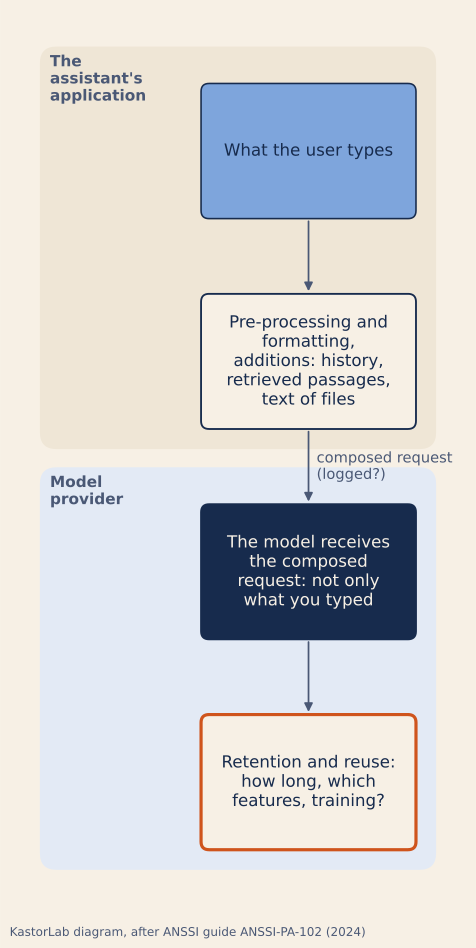
This shifts two questions. The application’s log may contain the typed input alone or the composed request: ANSSI wants both traceable, so that an event can be fully reconstructed [2]. And what goes to the model provider depends on its retention and reuse rules: for a system used through an API, CNIL writes that control of the system is then “quasi exclusivement dans les mains du fournisseur” (almost entirely in the provider’s hands) [3].
What to check with your provider
These five questions go to the vendor of the assistant, who must also answer for the model provider it calls. They hold without Nestor and complement the three in the previous article on conversations.
- What does the request the model receives contain, compared with what the user typed? A good answer lists the additions (history, retrieved passages, text of files, images), says when the application makes them, and can show the composed request for a given message.
- What happens to an attached file: which text, which images, for how many messages? A good answer says whether the extracted text leaves alone or with page images, whether the file goes out again with each following message because it is in the history or is retrieved on demand, and what any masking covers, text as well as images.
- What is logged, for how long, and who can read it? A good answer tells the typed input from the composed request, names the processing done before sending and the calls to additional data, sets a retention period, and protects the log like the data it contains [2].
- What does the model provider do with what it receives? A good answer gives a period per type of content (conversation, file, log, backup), a written no-training commitment that covers prompts, files, outputs and metadata and applies to every downstream provider [1], a setting that turns off reuse of usage data [3], and what falls outside those commitments.
- Can you find in your log a marker word that I choose? This is a test we propose: invent a word, write it in a message, put another in an attached file, send, then ask them to find both in the trace of what was sent. A good answer finds them quickly, says what was masked before sending, and how long the trace stays. If only the typed word shows up, or if there is no trace at all, you cannot check by this means what goes out.
How Nestor handles it
Nestor is KastorLab’s flagship product: we therefore have a direct interest in this subject.
If an external model is allowed: in a conversation, each message goes out with the history, the retrieved team memories and the text of attached files; to read an image or a scan without a capable local model, the image itself. The text (not the images) goes through automatic masking of certain personal data (emails, IBANs, numbers…). What is sent is logged and flagged in the conversation. This masking is not anonymisation.
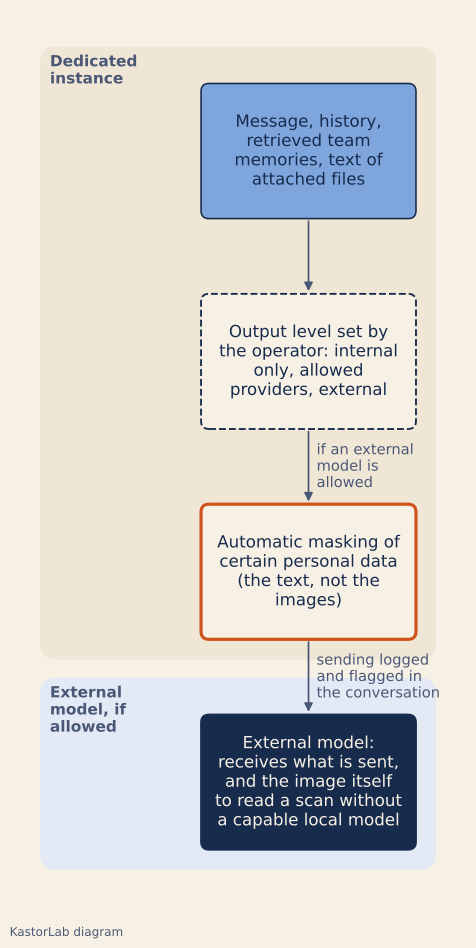
Three output levels (internal only, allowed providers, external) are set by the operator, never by a user screen. In the zero-leak mode, external providers are not even instantiated: only the models on the customer’s infrastructure answer. Masking of personal data takes place before any sending, with one audit line per crossing. In “internal only” mode: no external model, no web search.
For building an agent, the model receives the request, the names and the structure of the files (columns, formats, invented rows), never the real rows. You see what was sent. What still leaves, category labels included, is detailed in the article on structure.
Nestor runs in a dedicated instance for the company: an isolated stack, managed by KastorLab in the European Union (Team and Business plans), or deployed on the customer’s own infrastructure (Souverain plan). If the company allows an external model, it is no longer a closed loop.
Against your five questions, these lines answer questions 1 and 2. For question 3, they say that what is sent is logged, not what the log contains nor how long it is kept. They say nothing about what the model provider retains (question 4), and we have not run the test of question 5 on Nestor. If you want to run this exercise on your own tools and files, it is the starting point of an audit with us.
Limits
We tested no product: the marker-word test has not been tried with any provider. The facts come from pages read on 5 November 2026, including Glean’s page, updated on 26 April 2026, the ANSSI guide of April 2024 and the CNIL Q&A of July 2024; they change, and other providers may do things differently. The test shows what the application’s log keeps: a word missing from that log does not prove it did not leave, and it says nothing about what the model provider retains.
The article does not cover contract clauses and subprocessing, certifications, where the data is processed, connected accounts (when a mailbox or LinkedIn is connected, Nestor exchanges with that service) or voice dictation. Those are possible follow-ups.
For Nestor, it does not say what the log of what is sent contains, who can read it or how long it is kept; how the masking recognizes data beyond the examples cited; what happens to the text of an attached file in later messages; or what the model provider retains. For building, the “internal only” mode with a local model is slower and may not be enough for complex tasks. Our Security page also covers what is sent.
Sources
- 9 key questions for evaluating AI assistant vendors in 2026, The Glean Team, Glean, updated 26 April 2026, accessed 5 November 2026.
- Recommandations de sécurité pour un système d’IA générative, ANSSI-PA-102, version 1.0 of 29 April 2024, recommendations R29 and R34, accessed 5 November 2026.
- Les questions-réponses de la CNIL sur l’utilisation d’un système d’IA générative, CNIL, 18 July 2024, sections 5 and 6, accessed 5 November 2026.
- Using the Messages API, section “Multiple conversational turns”, Anthropic documentation, accessed 5 November 2026.
- Conversation state, OpenAI documentation, accessed 5 November 2026.